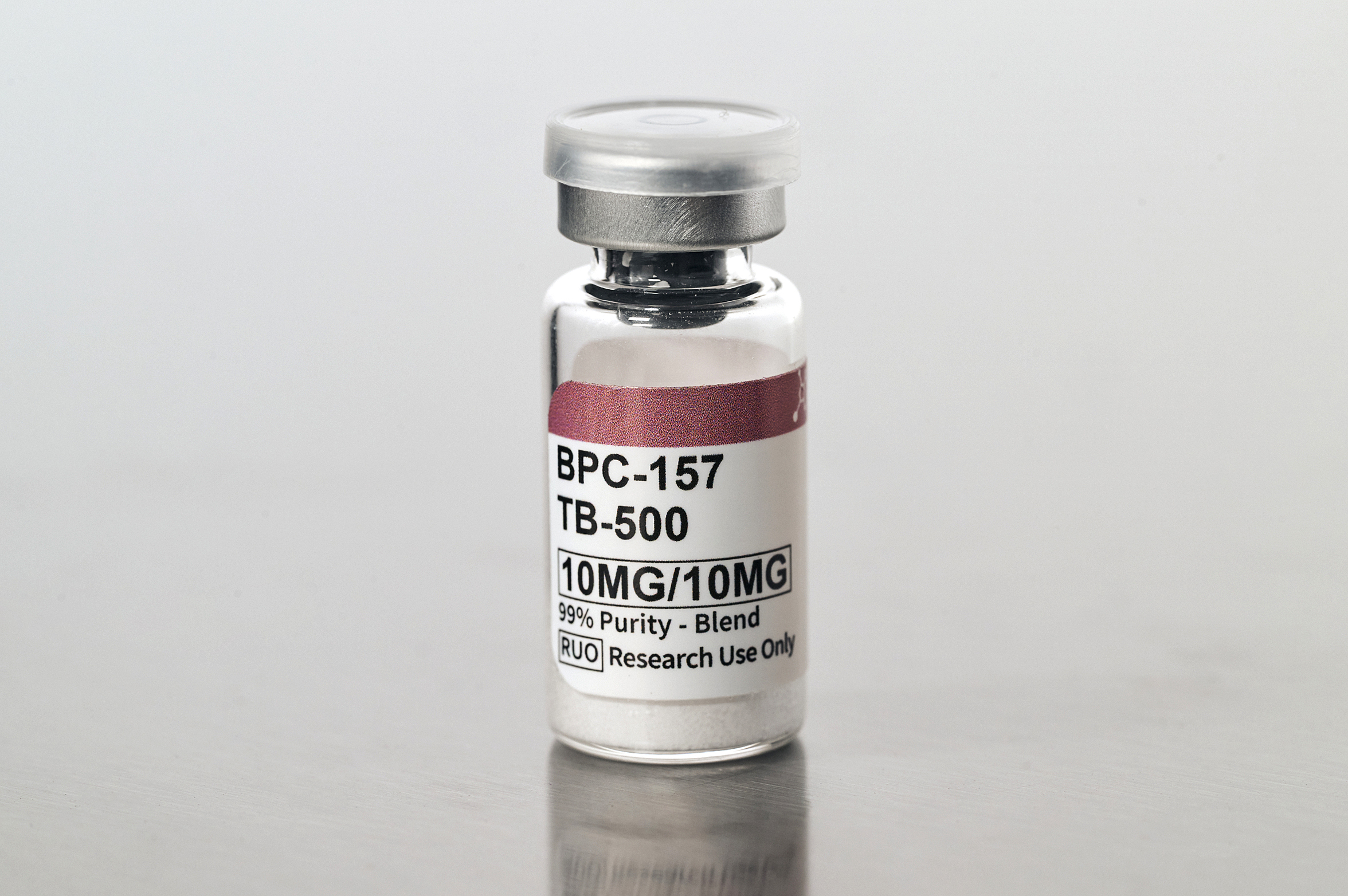
BPC-157/TB-500 Blend
The BPC-157/TB-500 blend combines two of the most extensively studied regenerative peptides into a single 20mg vial: Body Protection Compound-157 (BPC-157, 10mg) and Thymosin Beta-4 fragment (TB-500, 10mg). BPC-157 is a 15-amino-acid peptide originally isolated from human gastric juice, while TB-500 is a synthetic fragment of the naturally occurring 43-amino-acid protein Thymosin Beta-4. The rationale […]
Mechanism of Action
Product
Half-Life
BPC-157: approximately 30 minutes (plasma); TB-500: several hours. Biological effects persist beyond plasma clearance.
Administration Routes
Dosing Protocols
The BPC-157/TB-500 blend combines two of the most extensively studied regenerative peptides into a single 20mg vial: Body Protection Compound-157 (BPC-157, 10mg) and Thymosin Beta-4 fragment (TB-500, 10mg). BPC-157 is a 15-amino-acid peptide originally isolated from human gastric juice, while TB-500 is a synthetic fragment of the naturally occurring 43-amino-acid protein Thymosin Beta-4. The rationale for combining these two peptides lies in their complementary mechanisms of action. While both promote angiogenesis and tissue repair, they do so through distinct molecular pathways: BPC-157 primarily modulates the nitric oxide system and upregulates vascular growth factor receptors, whereas TB-500 operates through actin cytoskeleton regulation and endothelial cell migration.
Mechanism of Action
BPC-157 exerts its regenerative effects through multiple overlapping signaling cascades. The most well-characterized pathway involves direct activation and upregulation of vascular endothelial growth factor receptor 2 (VEGFR2). Research by Hsieh et al. (2017) demonstrated that BPC-157 time-dependently activates the VEGFR2-Akt-eNOS signaling axis, increasing both mRNA and protein expression of VEGFR2 in human vascular endothelial cells. Beyond the VEGF system, BPC-157 modulates nitric oxide (NO) synthesis through the Akt-eNOS pathway. BPC-157 also influences the expression of additional growth factors including epidermal growth factor (EGF), basic fibroblast growth factor (bFGF), and the early growth response gene EGR-1.
TB-500 operates through a fundamentally different molecular mechanism centered on cytoskeletal regulation. Thymosin Beta-4 functions as the principal regulator of monomeric actin availability in most cell types, sequestering approximately 40-50% of the total G-actin pool. This actin sequestration maintains a ready reserve of actin monomers that can be rapidly mobilized for cytoskeletal reorganization when migratory signals are received. Research has confirmed that the actin-binding motif of Thymosin Beta-4 is essential for its angiogenic activity, promoting endothelial cell migration, adhesion, tubule formation, and aortic ring sprouting.
Synergistic Potential: When combined, these peptides address tissue repair at multiple levels simultaneously. BPC-157 supports micro-circulation and growth factor balance while TB-500 drives structural remodeling through cytoskeletal reorganization. This multi-pathway engagement covers cellular recruitment, fibroblast function, extracellular matrix organization, angiogenesis, and the transition from inflammatory signaling to tissue remodeling.
Research Evidence
Sikiric et al. (2018, Current Pharmaceutical Design) characterized BPC-157 as a novel cytoprotective mediator with demonstrated vascular recruitment properties and consistent gastrointestinal tract healing efficacy across acute and chronic injury models. Hsieh et al. (2017, Journal of Molecular Medicine) demonstrated BPC-157 promotes VEGFR2 internalization and activates the VEGFR2-Akt-eNOS signaling pathway. Cerovecki et al. (2010, Journal of Orthopaedic Research) demonstrated that BPC-157 improved medial collateral ligament healing in rats across functional, biomechanical, macroscopic, and histological endpoints over a 90-day period.
Malinda et al. (1999, Journal of Investigative Dermatology) demonstrated that topical or intraperitoneal Thymosin Beta-4 increased re-epithelialization in rat full-thickness wounds by 42% at 4 days and up to 61% at 7 days, with increased collagen deposition and angiogenesis. Bock-Marquette et al. (2004, Nature) showed that Thymosin Beta-4 injection after coronary artery ligation in mice enhanced early myocyte survival and improved cardiac function. Smart et al. (2007, Nature) demonstrated that Thymosin Beta-4 induces adult epicardial progenitor mobilization and neovascularization following myocardial injury.
Clinical Applications Under Investigation
Musculoskeletal Healing and Recovery: BPC-157 has demonstrated efficacy in tendon, ligament, muscle, and bone healing models, while TB-500 actin-mediated cell migration and collagen deposition properties complement these effects. Research subjects have shown accelerated recovery in models of transected tendons, crushed muscles, and severed ligaments.
Joint Health: BPC-157 promotes ligament healing combined with TB-500 capacity to recruit progenitor cells and promote structural remodeling, suggesting potential applications in joint repair research. Both peptides influence extracellular matrix organization, a critical component of cartilage and synovial tissue maintenance.
Gastrointestinal Healing: BPC-157 has extensive preclinical evidence for GI tract repair, being native to human gastric juice and having demonstrated consistent efficacy across inflammatory bowel disease models, gastric ulcer models, and intestinal anastomosis healing.
Wound Healing: TB-500 enhances re-epithelialization, collagen deposition, and angiogenesis in dermal wound models, pairing with BPC-157 vascular recruitment properties. Both peptides accelerate the transition from the inflammatory phase to the proliferative and remodeling phases of wound healing.
Safety Profile
Across a wide range of doses and routes of administration in multiple animal models, no acute lethal or toxic dose has been reported for BPC-157. Researchers have been unable to identify a minimum toxic dose, and have reported no teratogenic, genotoxic, anaphylactic, or local toxic effects. Thymosin Beta-4 has been evaluated in Phase II clinical trials for ophthalmic applications without significant adverse events. Anecdotally reported side effects include nausea, headache, dizziness, and injection-site reactions for BPC-157, and mild fatigue for TB-500. No controlled human safety studies exist for the combination.
Neither BPC-157 nor TB-500 is approved by the FDA for human therapeutic use. Both peptides are prohibited by WADA under category S0 (Unapproved Substances). All research involving these peptides should be conducted in accordance with applicable regulations.
Side Effects & Warnings
Legal Status
Class
Research Status
PreclinicalHalf-Life
BPC-157: approximately 30 minutes (plasma); TB-500: several hours. Biological effects persist beyond plasma clearance.
Routes
Category
Healing & Recovery