Glow Blend
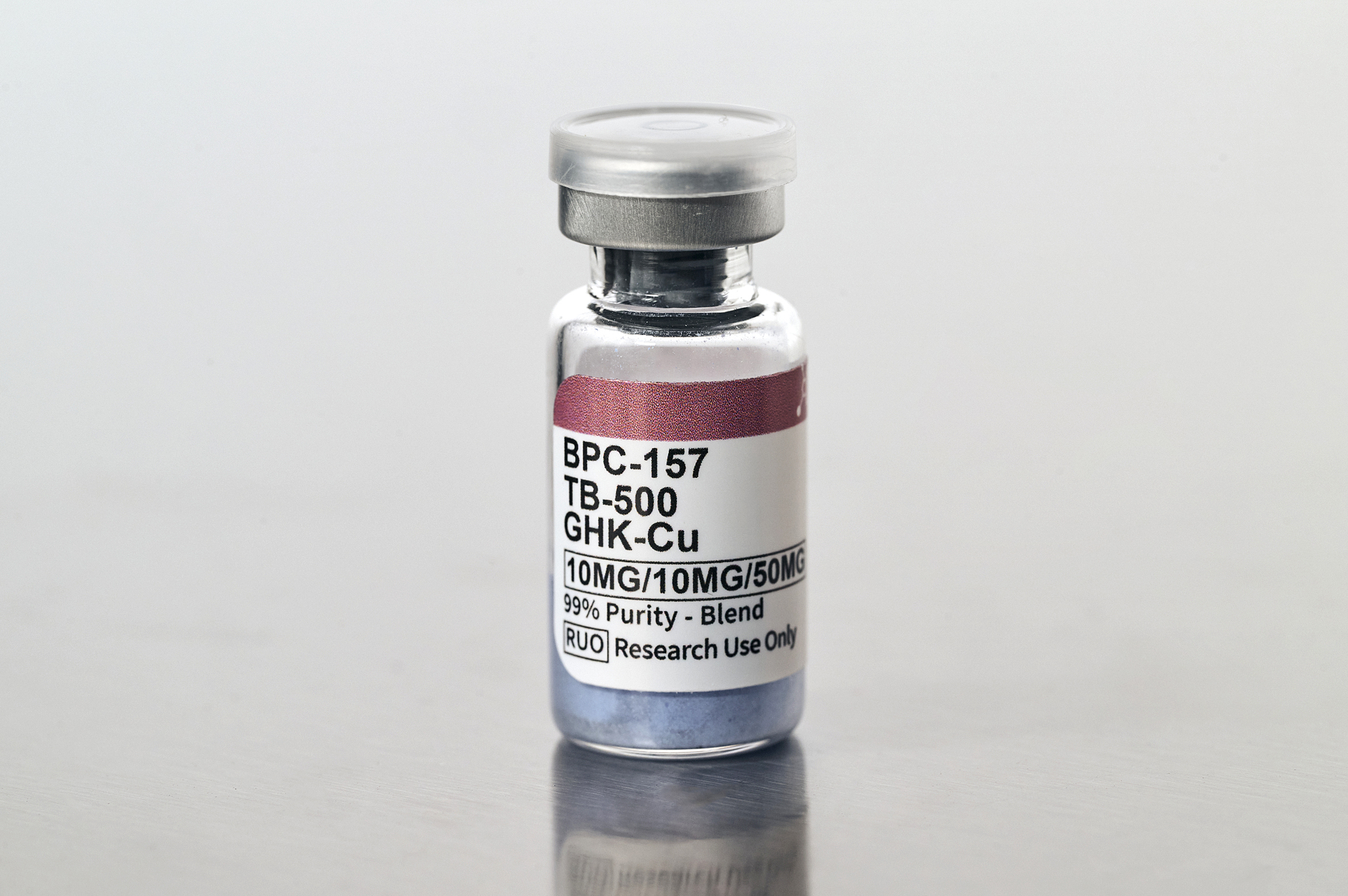
The Glow Blend is a multi-peptide formulation that combines BPC-157 (10 mg), TB-500 (Thymosin Beta-4, 10 mg), and GHK-Cu (Copper Peptide, 50 mg) in a single reconstitutable vial. This blend leverages the complementary regenerative mechanisms of three extensively studied peptides, each targeting distinct but overlapping pathways in tissue repair, skin remodeling, and cellular protection. Where […]
Mechanism of Action
Product
Half-Life
BPC-157: <30 minutes; TB-500: 1-2 hours; GHK-Cu: 1-2 hours. Biological effects persist beyond plasma clearance.
Administration Routes
Dosing Protocols
The Glow Blend is a multi-peptide formulation that combines BPC-157 (10 mg), TB-500 (Thymosin Beta-4, 10 mg), and GHK-Cu (Copper Peptide, 50 mg) in a single reconstitutable vial. This blend leverages the complementary regenerative mechanisms of three extensively studied peptides, each targeting distinct but overlapping pathways in tissue repair, skin remodeling, and cellular protection. Where BPC-157 drives vascular healing and growth factor upregulation, TB-500 promotes cellular migration through cytoskeletal modulation, and GHK-Cu orchestrates extracellular matrix remodeling and antioxidant gene expression.
Mechanism of Action
The three components of the Glow Blend act through distinct molecular mechanisms that converge on shared endpoints: angiogenesis, tissue remodeling, and inflammation resolution.
BPC-157 (Body Protection Compound-157) is a synthetic pentadecapeptide derived from a protective protein found in human gastric juice. Its primary mechanism involves activation of the VEGFR2-Akt-eNOS signaling cascade. BPC-157 promotes VEGFR2 internalization in vascular endothelial cells and time-dependently phosphorylates endothelial nitric oxide synthase (eNOS), triggering nitric oxide generation through the Src-Caveolin-1-eNOS pathway. BPC-157 also upregulates expression of vascular endothelial growth factor (VEGF), epidermal growth factor (EGF), fibroblast growth factor (FGF), and the early growth response gene EGR-1.
TB-500 (Thymosin Beta-4 Fragment) is a synthetic peptide based on the active region of thymosin beta-4, a 43-amino acid polypeptide found at elevated concentrations in platelets, macrophages, and wound fluid. Its primary molecular mechanism is high-affinity binding to monomeric G-actin, which prevents premature filament assembly and maintains an intracellular pool of actin monomers available for rapid polymerization. Beyond actin regulation, TB-500 promotes endothelial cell migration, stimulates angiogenesis, reduces pro-inflammatory cytokine production (including TNF-alpha and IL-6), and suppresses apoptosis.
GHK-Cu (Glycyl-L-Histidyl-L-Lysine Copper Complex) is a naturally occurring tripeptide-copper complex found in human plasma, saliva, and urine, with concentrations that decline significantly with age. GHK-Cu stimulates both synthesis and breakdown of collagen and glycosaminoglycans at nanomolar concentrations, and it modulates the activity of matrix metalloproteinases and their tissue inhibitors (TIMP-1 and TIMP-2), positioning it as a master regulator of extracellular matrix remodeling. GHK-Cu also upregulates at least 14 antioxidant genes while suppressing two prooxidant genes and increases superoxide dismutase (SOD) activity.
Synergistic Effects: BPC-157 initiates vascular recruitment and growth factor signaling. TB-500 enables the cellular migration necessary for tissue to respond to those growth factor signals. GHK-Cu then directs the remodeling phase, ensuring that new tissue is properly structured through balanced collagen synthesis and degradation, while providing antioxidant protection during repair. The overlapping angiogenic activity of all three peptides reinforces neovascularization, while the anti-inflammatory properties of both BPC-157 and TB-500 create an environment conducive to healing rather than chronic inflammation.
Research Evidence
Sikiric et al. (2018, Current Pharmaceutical Design) established BPC-157 role in vascular recruitment across multiple organ systems. Hsieh et al. (2017, Journal of Molecular Medicine) demonstrated BPC-157 promotes VEGFR2 internalization and activates the VEGFR2-Akt-eNOS signaling pathway using chick chorioallantoic membrane assays and rat hind limb ischemia models.
Goldstein, Hannappel, and Kleinman (2005, Trends in Molecular Medicine) established the dual role of thymosin beta-4 in actin regulation and tissue repair. Malinda et al. (2003, The FASEB Journal) demonstrated that the actin-binding site on thymosin beta-4 directly promotes angiogenesis. A Phase II clinical trial for dry eye (RGN-259) was reported by Dunn et al. (2015, Clinical Ophthalmology).
Pickart (2008, Journal of Biomaterials Science, Polymer Edition) provided a comprehensive overview of GHK-Cu effects on wound healing, skin rejuvenation, and organ protection. Pickart and Margolina (2018, International Journal of Molecular Sciences) demonstrated modulation of over 4,000 human genes. Leyden et al. (2002, Archives of Facial Plastic Surgery) demonstrated that topical copper tripeptide complex accelerated healing following CO2 laser resurfacing.
Clinical Applications
Tissue Healing and Wound Repair: BPC-157 enhances healing in tendon, ligament, muscle, bone, and gastrointestinal tissue models, complemented by TB-500 promotion of cellular migration into wound sites and GHK-Cu orchestration of extracellular matrix remodeling. The combined angiogenic effects ensure adequate blood supply to healing tissues.
Skin Rejuvenation and Anti-Aging: GHK-Cu is the cornerstone of the blend skin applications. Clinical studies have demonstrated that GHK-Cu cream improves elasticity, firmness, skin density, and thickness while reducing fine lines, wrinkles, and hyperpigmentation. Combined with BPC-157 growth factor upregulation (particularly EGF and FGF) and TB-500 ability to reduce scarring through suppression of myofibroblast formation, the blend addresses skin aging through multiple mechanisms.
Hair Growth and Follicle Support: GHK-Cu stimulates proliferation of dermal papilla cells, promotes VEGF production around hair follicles, and activates beta-catenin signaling critical for follicle regeneration. BPC-157 and TB-500 further support follicle health through enhanced local blood supply and anti-inflammatory protection.
Joint and Connective Tissue Repair: BPC-157 promotes growth hormone receptor expression in tendon fibroblasts, TB-500 facilitates cell migration and reduces inflammation in joint spaces, and GHK-Cu modulation of collagen synthesis and matrix metalloproteinase activity supports proper extracellular matrix remodeling.
Safety Profile
BPC-157 has undergone extensive preclinical safety evaluation across multiple species at doses ranging from 6 micrograms/kg to 20 mg/kg. No minimum toxic dose or lethal dose was identified. No teratogenic, genotoxic, anaphylactic, or systemic toxic effects were observed. TB-500 has been evaluated in Phase I and Phase II clinical trials for ophthalmic and cardiac applications without serious adverse events. GHK-Cu has the longest safety track record, having been used in topical cosmetic formulations for decades. As a naturally occurring human peptide, exogenous GHK-Cu at physiological concentrations is generally considered to have a favorable safety profile.
None of the three peptides in this blend are approved by the FDA for therapeutic use in humans. BPC-157 was placed on the FDA Category 2 list of bulk drug substances. All three peptides are prohibited in competitive athletics by WADA. The combination has not been studied in controlled clinical trials, and potential interactions between the components have not been formally characterized.
Side Effects & Warnings
Legal Status
Class
Research Status
PreclinicalHalf-Life
BPC-157: <30 minutes; TB-500: 1-2 hours; GHK-Cu: 1-2 hours. Biological effects persist beyond plasma clearance.
Routes
Category
Healing & Recovery