CJC-1295
A synthetic GHRH analog that stimulates pulsatile growth hormone release. Available with or without Drug Affinity Complex (DAC) for different pharmacokinetic profiles.
Normal Protocol
Advanced Protocol
Also Known As
Modified GRF 1-29, Mod GRF, CJC-1295 DAC, CJC-1295 No DAC, Tetrasubstituted GRF(1-29)
Mechanism of Action
Product
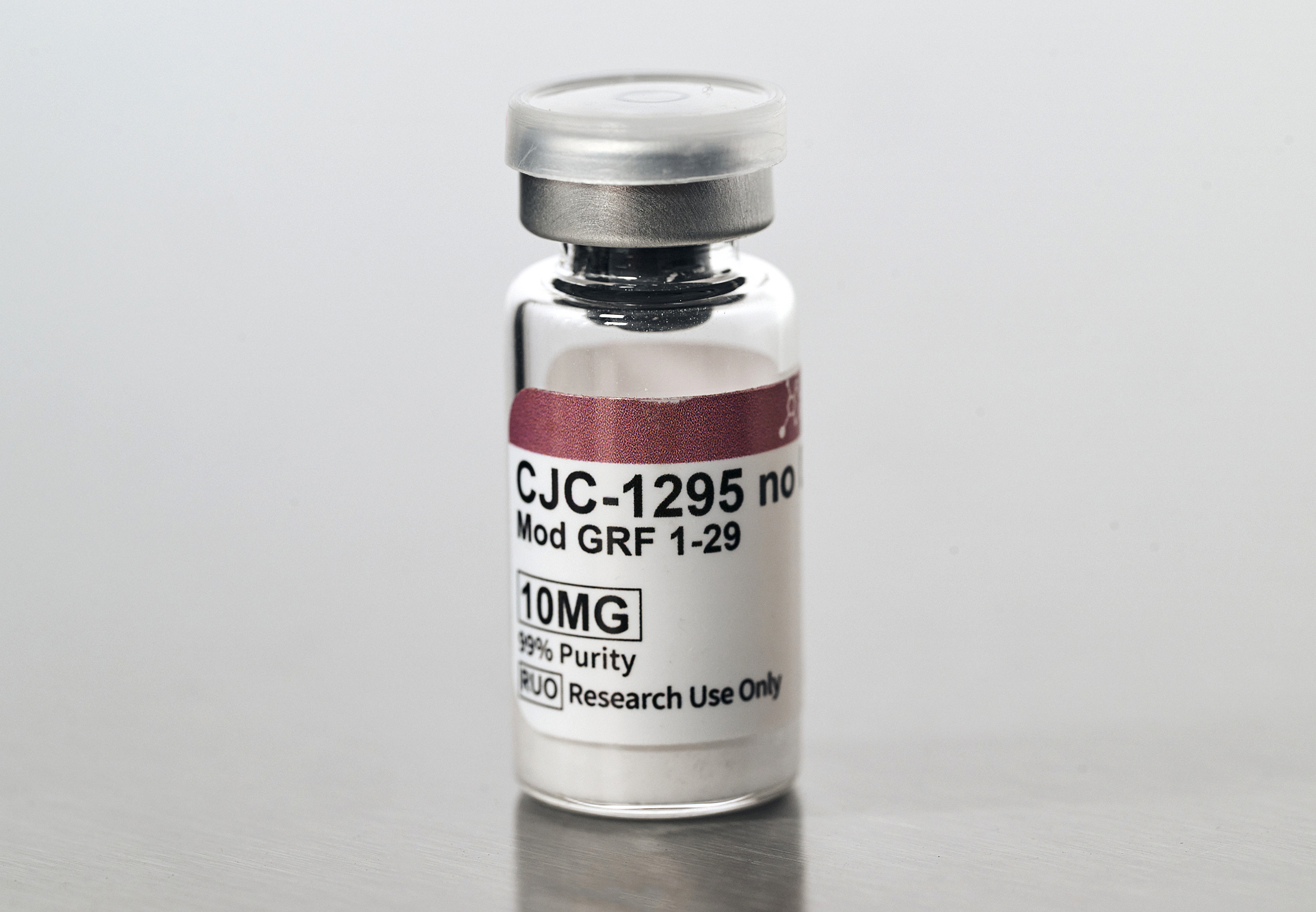
Half-Life
With DAC: ~8 days. Without DAC (Mod GRF 1-29): ~30 minutes
Administration Routes
Dosing Protocols
Key Research Findings
CJC-1295 is a synthetic analog of growth hormone-releasing hormone (GHRH) that stimulates growth hormone secretion from the anterior pituitary gland. It exists in two forms: CJC-1295 with Drug Affinity Complex (DAC) and CJC-1295 without DAC (also called Modified GRF 1-29 or Mod GRF).
Mechanism of Action
CJC-1295 binds to the GHRH receptor on somatotroph cells in the anterior pituitary, stimulating the synthesis and secretion of growth hormone. The DAC version covalently binds to serum albumin via a reactive lysine, dramatically extending its half-life from minutes to approximately 8 days. This creates sustained, elevated GH pulsatility rather than a single acute spike.
Without DAC (Mod GRF 1-29), the peptide retains the bioactive portion of GHRH (amino acids 1-29) with four amino acid substitutions (Ala2, Ala8, Ala15, Leu27) to prevent enzymatic degradation by dipeptidyl peptidase-IV (DPP-IV), extending its half-life to approximately 30 minutes.
Clinical Research
CJC-1295 with DAC has undergone Phase II clinical trials. In a study by Teichman et al. (2006), a single subcutaneous injection of CJC-1295 DAC resulted in sustained, dose-dependent increases in GH and IGF-1 levels for 6-8 days, with mean IGF-1 levels increasing 1.5 to 3-fold. After multiple doses, GH concentrations increased up to 10-fold and IGF-1 increased 1.5 to 3-fold over baseline for up to 28 days.
The non-DAC version (Mod GRF 1-29) is often preferred in research for its ability to produce a more physiological pulsatile GH release pattern when combined with a GHRP such as ipamorelin.
Comparison: With DAC vs Without DAC
CJC-1295 with DAC produces a sustained elevation in GH levels (a “GH bleed”) due to its extended half-life, which some researchers consider less physiological. CJC-1295 without DAC (Mod GRF 1-29) produces discrete GH pulses that more closely mimic natural GH secretion patterns, making it generally preferred for research protocols.
Side Effects & Warnings
Legal Status
Molecular Weight
With DAC: 3647.28 g/mol. Without DAC (Mod GRF 1-29): 3367.9 g/mol
Amino Acid Sequence
Tyr-D-Ala-Asp-Ala-Ile-Phe-Thr-Gln-Ser-Tyr-Arg-Lys-Val-Leu-Ala-Gln-Leu-Ser-Ala-Arg-Lys-Leu-Leu-Gln-Asp-Ile-Leu-Ser-Arg-NH2
Class
Research Status
Clinical TrialsHalf-Life
With DAC: ~8 days. Without DAC (Mod GRF 1-29): ~30 minutes
Routes
Category
Growth Hormone Peptides