Dihexa
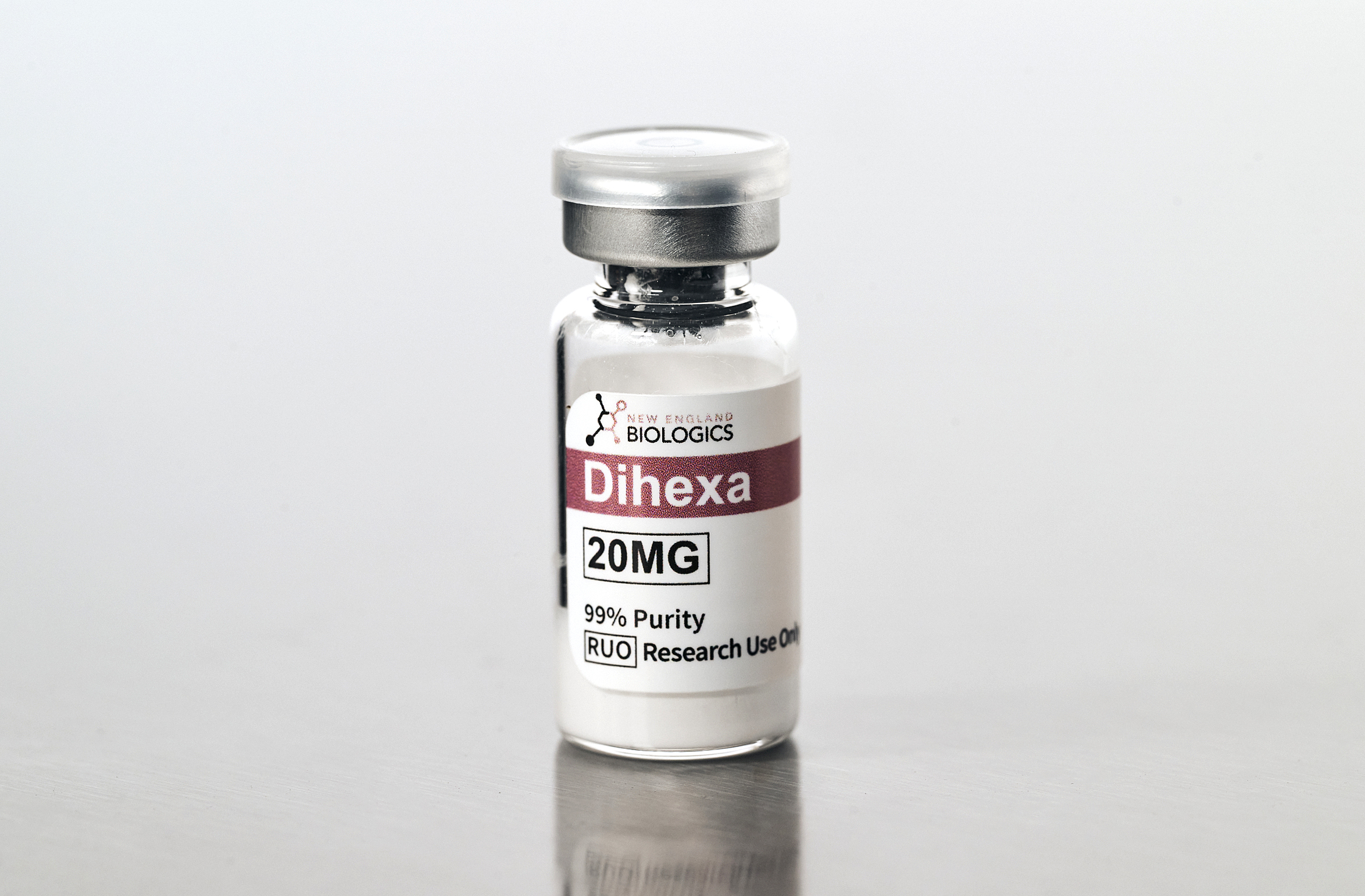
Dihexa is a potent cognitive-enhancing peptide derived from angiotensin IV. It is approximately 10 million times more potent than BDNF at promoting new synapse formation, making it one of the most powerful nootropic compounds studied to date.
Also Known As
N-hexanoic-Tyr-Ile-(6) aminohexanoic amide, Angiotensin IV analog
Mechanism of Action
Product
Half-Life
Under investigation; designed for extended stability
Administration Routes
Dosing Protocols
Key Research Findings
What is Dihexa?
Dihexa (N-hexanoic-Tyr-Ile-(6) aminohexanoic amide) is a small peptide analog of angiotensin IV developed at Washington State University. It was designed to be a stable, blood-brain barrier-penetrant compound that activates the hepatocyte growth factor (HGF)/c-Met receptor system. Dihexa has gained significant attention in the nootropics community due to its extraordinary potency in promoting synaptogenesis (new synapse formation), which is critical for learning, memory, and cognitive function.
Mechanism of Action
Dihexa acts as an allosteric activator of the HGF/c-Met receptor system in the brain. It facilitates the dimerization of c-Met receptors, which triggers signaling cascades involved in neuronal growth, synaptic plasticity, and synaptogenesis. This mechanism is distinct from most nootropics — rather than modulating neurotransmitter levels, Dihexa promotes the physical formation of new synaptic connections between neurons. It has been shown to be approximately 10 million times more potent than BDNF (Brain-Derived Neurotrophic Factor) at driving new synapse formation.
Potential Benefits
- Cognitive enhancement — Promotes new synapse formation for improved learning and memory
- Neuroprotection — Supports neuronal survival and growth through HGF/c-Met activation
- Memory restoration — Has shown ability to reverse cognitive deficits in animal models of dementia
- Synaptic plasticity — Enhances the brain’s ability to form and strengthen neural connections
- Blood-brain barrier penetrant — Designed to cross the BBB effectively for CNS activity
- Neurogenesis support — May support the growth of new neurons in key brain regions
Research Overview
Research published by Harding et al. at Washington State University (2013) demonstrated that Dihexa could reverse scopolamine-induced cognitive deficits in rats and restore cognitive function in aged animals. The compound showed remarkable potency in promoting spinogenesis (dendritic spine formation) and synaptogenesis in hippocampal neurons. Studies have also investigated its potential applications for Alzheimer’s disease and other neurodegenerative conditions. While preclinical results are highly promising, human clinical trials have not yet been completed.
Administration
Dihexa requires a special reconstitution process using DMSO. Dissolve the 20mg lyophilized powder in 0.5ml DMSO, then slowly add this mixture drop-by-drop to 3.5ml of bacteriostatic water in a separate mixing vial (total 4ml solution). This process must be done very slowly to ensure proper mixing.
Average dosing: Using an insulin syringe marked 1-100 units, draw 100 units for a single dose.
Advanced dosing: Using an insulin syringe marked 1-100 units, draw 40 units for a single dose.
Advanced Dosing Video
Transcript: This is our peptide dihexa 20mg. This reconstitution is a little bit more complicated so please pay close attention. You’re going to need DMSO, you’re going to need an empty vial, and you’re also going to need bacteriostatic solution along with two drawing syringes. The first step is going to be to draw a half a milliliter of DMSO solution into a drawing syringe. We’re going to add this half a milliliter into our peptide vial and dissolve that powder. Now we’re going to set that aside and let that dissolve and recap that syringe. Taking a new syringe we’re going to draw three and a half milliliters of bacteriostatic solution. This syringe only holds three milliliters of water so we’re going to have to go back for a second time. Let’s start with three full milliliters of bacteriostatic solution. We’re going to add this to our empty vial. We’re now going to go back into another half a milliliter of bacteriostatic solution and add this again to our empty vial. Now going back to our previously used drawing syringe we’re going to withdraw the DMSO and peptide solution into that same drawing syringe. It should measure about a half a milliliter by the time you pull it all out. Now using this syringe and our new vial of water we’re going to add this extremely slowly, in fact painfully slowly drip by drip until both solutions are combined. For our advanced dosing with Dihexa using an insulin syringe marked one to one hundred units we’re going to draw forty units.
Side Effects & Warnings
Legal Status
Molecular Weight
Approximately 507.6 g/mol
Class
Research Status
PreclinicalHalf-Life
Under investigation; designed for extended stability
Routes
Category
Cognitive & Neuroprotective