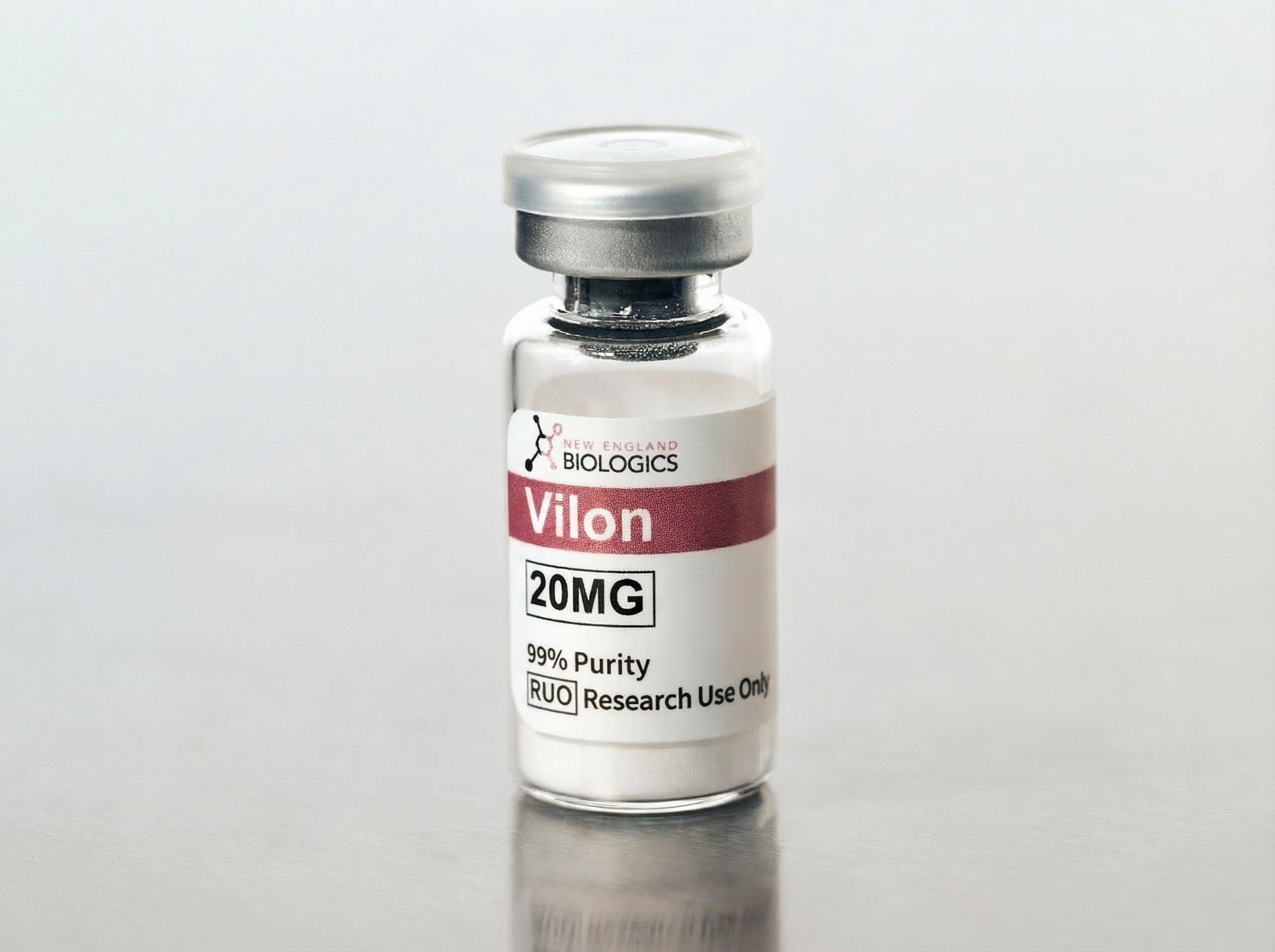
Vilon
A synthetic dipeptide (Lys-Glu) developed by the same Russian research team behind Epitalon. Vilon acts as a thymic peptide bioregulator with immunomodulatory and geroprotective properties, shown to restore immune function in aging and increase mean lifespan in animal studies.
Also Known As
Lys-Glu Dipeptide, T-38
Mechanism of Action
Product
Half-Life
Minutes (dipeptide — rapidly metabolized)
Administration Routes
Dosing Protocols
Key Research Findings
Overview
Vilon (Lys-Glu) is a synthetic dipeptide bioregulator developed by Professor Vladimir Khavinson and the St. Petersburg Institute of Bioregulation and Gerontology. It is the shortest known peptide with demonstrated immunomodulatory activity. Vilon was designed to mimic the activity of thymic peptides and is part of Khavinson’s broader program of peptide bioregulators — short synthetic peptides (2-4 amino acids) that regulate gene expression in specific tissues.
Mechanism of Action
Vilon interacts with DNA, particularly in the promoter regions of genes involved in immune function and cell differentiation. It has been shown to: restore thymic function and T-lymphocyte differentiation in aged animals; modulate chromatin structure, making immune-related genes more accessible for transcription; enhance expression of interleukins IL-2 and IL-7; increase natural killer (NK) cell activity; and promote thymocyte proliferation. The mechanism is thought to involve epigenetic regulation rather than traditional receptor-ligand signaling.
Clinical Evidence
Russian clinical studies (limited peer review in Western journals) report: restoration of immune parameters in elderly patients; increased T-cell counts and NK cell activity; improved immune response to vaccination in elderly. Animal studies show: 24-36% increase in mean lifespan in mice and Drosophila; reduced tumor incidence in aging mice; restoration of thymic architecture. A 15-year longitudinal study of elderly patients using peptide bioregulators (including Vilon) reported a 28% reduction in mortality rate compared to controls.
Dosing Protocols
Oral: 10-50 mcg daily in courses (10-20 days, 2-4 times per year). Subcutaneous: 10-20 mcg daily for 10-14 day courses. Russian clinical protocols typically use cyclical dosing: 10-day course repeated every 3-6 months. Some protocols combine Vilon with Epitalon for synergistic geroprotective effects.
Side Effects
Excellent safety profile reported across multiple Russian studies. No significant adverse effects documented. As a naturally-derived dipeptide (both amino acids are endogenous), systemic toxicity is extremely unlikely. May theoretically overstimulate immune function in autoimmune conditions — caution advised.
Side Effects & Warnings
Legal Status
Molecular Weight
275.30 Da
Amino Acid Sequence
Lys-Glu
Class
Research Status
PreclinicalHalf-Life
Minutes (dipeptide — rapidly metabolized)
Routes
Category
Longevity & Anti-Aging